


The statements made and opinions expressed in this publication are solely the responsibility of the author(s) and do not necessarily reflect the opinions of the Security in Context network, its partner organizations, or its funders.
By Enrique Dussel Peters
Enrique Dussel Peters is a Professor at the Graduate School of Economics at Universidad Nacional Autónoma de México (UNAM) and is the Coordinator of the Center for Chinese-Mexican Studies (Cechimex) of the School of Economics at UNAM and of the Academic Network of Latin America and the Caribbean (Red ALC-China). He holds a PhD in Economics from the University of Notre Dame. He is author of chapters and books on political economy, industrial organization, development, processes of segments of global value chains and the socioeconomic Latin America and Caribbean-China relationship. Web address: dusselpeters.com
This paper was prepared for the online conference, The China Effect: Rethinking Development in Latin America and the Caribbean, that took place on December 3, 2025, and organized by the University of Oklahoma Center for Peace and Development, the Security in Context Network (SiC), and the Center for Chinese Mexican Studies (Cechimex) at the School of Economics at the National Autonomous University of Mexico (UNAM).
Abstract: These initial reflections will deepen the understanding of China’s contemporary socioeconomic development and begin an explicit and detailed discussion on its potential impact in development economics in the 21st century. As presented in the first section, so far important authors in development economics have not explicitly begun with such a conceptual effort. The argument in these reflections is that the size, dynamics and development results of China since reform and opening-up require an explicit comprehension and integration of China’s development performance. Development economics is still in "doldrums" in the third decade of the 21st century and has not acknowledged China’s significant structural socioeconomic change, particularly in terms of its firm’s public sector, including China’s profound technological upgrading process and its ability to eradicate absolute poverty. Development economics cannot “abstract” from these profound conditions and challenges. These reflections invite development economists to explicitly integrate a discussion of China, not necessarily as part of Asia or East-Asia.
Citation: Dussel Peters, Enrique, 2026. “Does China’s Contemporary Development Have Implications on Development Economics? First Conceptual Reflections,” Security in Context Research Paper 26-02. April 2026, Security in Context.
Introduction
The analysis on China and on the Latin American and Caribbean (LAC)-China socioeconomic relationship has received increasing attention in LAC in the 21st century. Particular attention has gone to international trade, investments, financing, infrastructure projects, employment, as well as on technology transfer, specific global value chains, and the territorial impact in LAC in its trade with China.1 An increasing number of researchers, but particularly of institutions in LAC and China, have engaged in such examinations. In 2026 there is no question about China’s increasing global role given the nation’s GDP, the eradication of absolute poverty and the effective improvement of the quality of life of its population since the 1970s (known as the process of “reform and opening-up”), and its ability to compete against “Western” countries in specific global value chains at the firm-level in which they already account for the leadership in innovation. Such a performance would have been unthinkable at the beginning of the 21st century.
Most of the analysis in LAC, China, and other countries on these issues is, however, mainly descriptive. This descriptive work situates China’s development process in the last five decades to elucidate China’s contemporary socioeconomy to the rest of the world today. However, is this sufficient today, after several decades of socioeconomic analysis on China in LAC?
The rest of the paper is organized as follows. The next section introduces debates and discussions in development economics in general and specifically on the limited integration of China’s recent development experience in development economics. The third part will characterize China’s development since reform and opening-up since the late 1970s. The main contribution of this analysis, however, and in order not to continue to fall into the “descriptive trap,” will be to highlight the importance of China’s public sector in its contemporary socioeconomic development and its surprising characteristics: competition, coordination, and the omnipresence of public property. Does property matter in economic development? The final section will integrate these findings into the “doldrums” of contemporary development economics.
These are preliminary reflections on broad topics with enormous implications for the proposed issues. There are more questions to ask for future scholars interested in LAC, China, and contemporary development economics.
Has China’s Recent Development Experience Been Integrated into Contemporary Development Economics?
Most socioeconomists discuss development, industrial organization, and international trade with concepts defined in the second half of the 20th century: absolute and comparative advantages since Adam Smith and David Ricardo, two-sector two-country models of an open macroeconomy since the 1970s, and an increasing group of heterodox and structuralist schools of thought, including Marxist, post-Keynesian and “eclectic paradigms” (Dunning 1980) based on firm-level analysis and industrial organization structures. Nevertheless, recent discussions of development policies acknowledge that China chose a different development path than most developed and developing countries but do not explicitly integrate China’s development experience in contemporary development theory.2
In LAC, debates on the potential of second-generation export-oriented industrialization and new import-substitution policies persist (Dussel Peters 2025:9-23). Development economics, from this perspective, is apparently in a similar “doldrum” as described by Arthur Lewis (1984:1) in the 1980s.3 The “inefficiency of inequality” examined by ECLAC (2018) is substantial for LAC in the third decade of the 21st century (and also for the rest of the world).4
Even heterodox development economists such as Dani Rodrik have not examined China’s development experience until 2025. China is in his analysis usually as an example of East Asia, together with Japan, South Korea and/or Taiwan in contrast to other developing countries and LAC. His first analysis on China highlights China’s industry and export structure and reflects that “…100% foreign owned firms are a rarity among the leading players in the [consumer electronics] industry. Most of the significant firms tend to be joint ventures between foreign firms and domestic (mostly state-owned) entities (Rodrik 2006:21); this line of thought, however, is not continued in his later research.5 Since then, China continues to be an example – together with a group of East Asian countries and India6 – of rapid growth and industrialization, inequality, growth of middle-income deciles, and more recently as an increasing limitation for the rest of the developing world to industrialize (or rapidly de-industrialize) (Rodrik 2013). Industrial policies for developing countries, and based on China’s massive industrialization and policy-instruments in the 21st century, is from this perspective, impracticable and not an effective development tool.7 There is no in-depth analysis on China’s development path but a general understanding of China’s common and abstract development policies.
There is another recent school of thought that has not been sufficiently understood in development economics. The work of Gary Gereffi and Jennifer Bair, among several others since the 1990s, has highlighted the importance of “global value chains” (GVC) (Gereffi and Korzeniewicz 1994; Bair and Dussel Peters 2006). Rather than a conceptual framework, the main contribution of these authors is methodological (Gereffi 2018:13) and frames development according to specific GVC, (products and processes in segments in space and time), empirical research, and resulting conceptual enrichment. Additional reflections include macro, meso, micro and territorial analysis to formulate detailed development policies, together with academics, industrial organizations, and public officials (Dussel Peters 2018).
Such a methodological approach has enormous implications for contemporary development theory. It has opened debates in development theory regarding different results and policy proposals from a macro, meso, micro, and territorial perspective. Associations between GDP and exports, for example, can substantially differ, even in sign, at each of these levels, which does not necessarily result in “eternal and existential” differences and misunderstandings between specialists in each of these fields, but should enrich the conceptual debates, policy-oriented suggestions, and discussions with business organizations and NGOs. Quantitative and qualitative associations between GDP and exports (or foreign direct investments) can be significantly different at the macro, meso, micro, and territorial level, and socioeconomists should accept these methodological differences and results to integrate them conceptually. Macroeconomic variables such as investments, consumption, and exchange rates should allow for a micro, meso and territorial discussion on intra and inter-firm relations and policies, as well as for an understanding of specific GVCs and their variety of firms to distinguish between bananas and semiconductors. The implications for development theory are substantial: an in-depth analysis of segments of GVC of products and processes in time and space including macro, meso, micro and territorial aspects in the short, medium, and long run (Dussel Peters 2018). Recent results (Gereffi, Bamber and Fernández-Stark 2022:13-16) go beyond macroeconomic findings and highlight an important territorial interaction in China’s development model, specifically between local and national government policies (such as industrial, FDI, and export-oriented measures).
Considering these findings and acknowledging the importance of China’s rapid development and its relationship with LAC (ECLAC 2025; Ray and Dussel Peters 2025), what are the impacts on development theory in LAC and globally? Can we continue teaching, publishing, and proposing policies on growth and development without specifically integrating China in our courses and analyses? What are the quantitative and qualitative differences in the development process of China vis a vis LAC in the last 50 years? Are there any learning processes, beyond cultural and millennial differences?
Development with Chinese Characteristics since the 1970s
This chapter will examine two issues. First it will cover a group of quantitative and comparative stylized conditions of China’s development in the last decades, which are relevant to understand the depth of China’s development process since reform and opening-up. The second part will examine the concept and relevance of the public sector in China, as a critical factor to understand China’s recent development process.
What are the main characteristics of China’s development process in the last decades, and specifically since the late 1970s?8
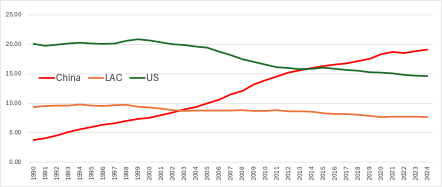
China has been growing substantially since the 1970s, its GDP (measured in current US$) in 2024 represented 9,789% (or increased 98 times) of its GDP of 1980; it represented 908% and 1,006% of the US and LAC. As a result, China quickly closed its GDP gap with the US and became the largest economy in the world, measured in purchasing power parity (PPP) since 2016, surpassing the US (figure 1). What distinguishes China from other Asian or East Asian countries is not only its size and growth dynamism, but also its GDP per capita dynamics considering its vast population of almost 1.4 billion: during the full 1980-2024 period the average annual growth rate (AAGR), measured in current $US, was of 10.1%, compared to LAC (3.7%) and the US (4.4%) (WB 2026); China’s GDP per capita AAGR was particularly significant during 2001-2024 (11.6%). Finally, China’s GDP per capita has been closing its gap with the US – and surpassed LAC since 2016 – but still only represents 15.74% of the US` GDP per capita in 2024. This opens a significant new paradox: the biggest economy of the world still has a huge GDP per capita gap with other countries.
Figure 1: China, LAC and the US GDP (share over world GDP in PPP in current USD)
Beyond GDP and GDP per capita measurements, China’s economic development since reform and opening-up is significant. China’s development is based on extremely high domestic gross savings over GDP – averaging 41.8%% during 1980-2024 and more than doubling LAC and the US – channeling them through its domestic credit system – averaging its domestic credit to its private sector over GDP for 118.2% during 1985-2024, i.e. levels three times higher than LAC and similar to levels of US in the 2020s – and resulting in extraordinarily high levels of gross capital formation over GDP of 39.7% during 1980-2024; almost doubling LAC and US’s accumulation throughout the period (WDI 2026).
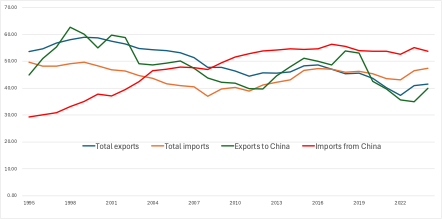
From a development and LAC perspective, China’s performance is important in terms of its effective technological upgrading. ASPI’s analysis (ASPI 2024) acknowledges that during the period of 2019-2023, Chinese firms were leading in 57 of 64 “advanced technologies”; during 2003-2007 US-firms did so in 60 of 64 advanced technologies (and Chinese firms in only three). There are many indicators regarding the technological upgrading process of China vis a vis the US,9 including bilateral trade among the two biggest economies. Based on US data, Figure 2 reflects, on the one hand, that the US’s medium and high level technological content of its foreign trade has shifted significantly, both in a falling tendency of its technological level in exports and increasing share of its imports. Since 2017, for the first time, the US foreign trade presents an increasing gap in the medium and high-tech level of its exports and imports (Figure 2). Most relevant, and in the development discussion of this paper, is the bilateral trade between the US and China: medium and high-tech exports to China were significantly higher than imports from China (with a difference of more than 20% between 1996-1999), but this gap fell significantly until 2008; since then the gap between the medium and high-tech of the bilateral trade between the US and China shifted in China’s favor and accounted for almost 14% in 2024 (Figure 2).
Figure 2: Total Trade and Bilateral Trade of the US with China in Medium and High-Technology Goods (percentage shares over total US trade): 1995-2024
Acknowledging the limitations of China’s contemporary growth and development process prompts these questions:10 does China’s development model present a traditional growth trajectory? Are its savings channeled through its banking and financial sectors to an investment process with exorbitant shares of gross capital formation contributing to its growing GDP? As Napoleoni (2011) asks: Why do Chinese Communists Make Better Capitalists Than We Do? Is this mainly a result of industrial policies, as discussed earlier?
The following section highlights the public sector in China since 1949, reform, and opening-up, as the main institution to comprehend China’s development model today. The public sector has significant conceptual and policy implications for understanding development in China.
The public sector in China is a historically unique institution: the result of specific conditions created by the People’s Republic of China in 1949, and Deng Xiaoping’s efforts after Mao Zedong’s death in 1976.11 His pragmatic policy-style under the shadow of Mao emphasized the importance of world-class education and science and technology for China, priorities that were difficult to imagine in the late 1970s in China, which struggled to satisfy its population’s basic material needs. Most importantly, China at that time lacked most relevant institutions it has today, with the exception of the Communist Party of China (CPC). One Deng’s first measures was to implement the mandatory retirement system within the CPC and the creation of local party “leadership teams” that implemented at the local level CPC initiatives and priorities with a high level of flexibility and were to be judged by their results and contributions to China’s growth. These initiatives ran counter to the Mao era policies. It is under these particular historical, political, and socioeconomic conditions – including precarious economic conditions and a GDP per capita in 1980 of only $US195 or 9% of LAC’s GDP per capita and 1.55% of the US – that Deng’s cautious and pragmatic development approach took place without any conceptual pretensions that could generate tensions with Mao’s legacy.
Under the absolute leadership of the CPC, China’s public sector is the sum of its institutions and firms of the central government, provinces, cities and municipalities (Dussel Peters 2025:28-34). The goal-driven and meritocratic system of the CPC is fundamental for understanding its functioning. China’s public sector is defined by two characteristics: a profound competition within the public sector (and with private and foreign firms), and, a short, medium, and long run coordination by the CPC. These two characteristics generate a historical unique and powerful institution that is significant to comprehend China’s socioeconomic development process since reform and opening-up.They are the answer to Nappoleoni’s question.
The first feature of the public sector in China is competition within its institutions and firms. This is a result of the aforementioned leadership teams created by Deng and the goal-driven hierarchy of the CPC: the pragmatic meritocracy of the CPC highlighted the development results associated with the short, medium, and long-term goals proposed by the CPC, i.e. the improvement of China’s population living conditions, environmentally-friendly policies, efforts to improve R&D, high-quality growth and development, as well as recent high quality productive forces. This sui generis process was significant for public officials to attain promotions in the CPC. As a result of this complex socioeconomic institution, Chinese public firms allowed for relatively high levels of competition between firms participating in the public sector.12
The second characteristic of China’s public sector is the short, medium, and long term coordination of CPC, with a pragmatic, meritocratic and goal-driven hierarchical political structure. The CPC is not only legitimized by China’s constitution – “Leadership by the Communist Party of China is the defining feature of socialism with Chinese characteristics” (The State Council of the People’s Republic of China 2019) – it has an “omnipresent” qualitative and quantitative role in China’s socioeconomy. This role is the result of its central government, provinces, cities, municipalities, and economic and political institutions such as the State Council and the powerful National Development Reform Commission (NDRC), as well as the 21 Ministries of the State Council (including the Ministry of Science and Technology, of Industry and Information Technology, and Informatic Technology, Finance, Commerce, and the People’s Bank of China). All of these organizations have hundreds of institutions at the central government, cities, provinces and municipalities and constitute a massive coordination possibility that recognizes corruption and inefficiencies within the public sector in China. The CPC not only coordinates the firms of its own property, but also has instruments – such as banking and financial system, development policies, and massive public spending of the public sector – to generate incentives for private and foreign firms. From this perspective, the public sector is a powerful institution with an effective capability to implement policies in the short, medium, and long run. China’s contemporary public sector is incommensurable with similar institutions in LAC and the US.
From a quantitative perspective, what is its relevance to the contemporary public sector in China? In 2026, the property of China’s public firms accounts for at least 40% of its GDP, no other country in the top 20 GDP list accounts for 5%. From this perspective, the “omnipresence of the public sector in China” (Dussel Peters 2025:26-39) is a critical feature of China’s development process. Quantitatively the property of the public sector in agriculture is significant, declining in industry and manufacturing, and high and increasing in services. We see important new ownership structures in services and new hybrid forms of property where the public sector awards control of the company with a small share of the respective firm. These direct ownership structures are in addition to massive financing in the financial and banking sectors and generating significant incentives for the respective public, private, or foreign Chinese firms to integrate to the strategies of the public sector. Public property and massive incentives for private and foreign companies are a significant characteristic of China’s development process since reform and opening-up in the late 1970s.
Conclusion: What Can We Learn in Development Theory in LAC?
These initial reflections deepen our understanding of China’s contemporary socioeconomic development and begin a detailed discussion of its potential impact in development economics in the 21st century. Development economics authors have not made a conceptual effort to differentiate China from other Asian and East Asian countries. However, its size, dynamics, and development results since reform and opening-up require an explicit comprehension and integration of China’s development performance to allow for a detailed discussion of its implications for development economics.
As discussed in the second section, China’s socioeconomic development since reform and opening-up is a main legacy of Deng Xiaoping and includes the eradication of absolute poverty, the massive improvement in the quality of life of China’s population, and China’s rise to an industrial powerhouse. Also relevant is China’s increasing integration of new technologies as it becomes a technological leader in critical global value chains, i.e. from integrating technologies through FDI and exports to generate disruptive innovations. This process has been particularly profound in the 21st century in comparison to LAC and even the US.
These initial reflections highlight the quantitative and qualitative relevance of China’s public sector as a critical factor in its contemporary socioeconomic development. China is not “one more” Asian or East Asian country, but presents a historical unique institution that is not comparable to other countries today. Its main two characteristics – profound competition within public firms and with private and foreign companies, as well as short, medium, and long term coordination – result in highly competitive firms in China’s domestic market and globally. The incentive structure discussed in the second section is significant to understand these results.
These initial reflections invite discussion for development economics from at least three perspectives:
First, to integrate in detail China’s contemporary socioeconomic development in development discussions, both in teaching, but also regarding policy proposals for the Global South. It would be naïve to assume that China’s experience could be “copied and pasted” in other countries, but, for many development economists China is still an abstract and “one more” case study in Asia and/or East Asia. Given China’s contemporary socioeconomic development, this is clearly not sufficient.
Secondly, these reflections allow for a concrete discussion of the state and public-private relations, beyond specific trade, industrial, technology and other potential policies. China’s public sector, as discussed in the second section, requires a detailed analysis on the importance of public property in development economics. The issue of property – significant in debates on import-substituting industrialization in LAC in the 20th century, for example – is not new, but China’s experience includes from the beginning the requirement of competition and short, medium, and long run coordination; this runs against arguments on infant industries and structural bottlenecks to allow for initial protections. Domestic and global competition and coordination should be implemented from the beginning of the creation of such public firms. As the Chinese contemporary case shows, public property is particularly important in strategic global value chains, and in time public property could be privatized. China’s development reflects a pragmatic discussion on public property with plenty of different contemporary property forms and incentives for public, private and foreign firms.
Finally, the proposed discussion of the potential implications that public property has for development could reinvigorate development economics, both conceptually, as well as in policy terms. It does not neglect the importance of particular policies (for example on industrial policy), but highlights that at least in the Chinese case, public property and other massive incentives for private and foreign firms, go far beyond individual policies. Public firms in China are supported by industrial policy and hundreds of other policies, since they are the property of the public sector (central government, provinces, cities and municipalities). Such an explicit integration of public property could substantially enrich policy options for the Global South and development economics.
References
ASPI (Australian Strategic Policy Institute). 2024. ASPI’s two-decade Critical Technology Tracker: The rewards of long-term research investment. Australia: ASPI.
Bair, Jennifer and Dussel Peters, Enrique. 2006. “Global Commodity Chains and Endogenous Growth: Export Dynamism and Development in Mexico and Honduras”. World Development 34(2), pp. 203-221.
The State Council of the People’s Republic of China. 2019. Constitution of the People’s Republic of China. The State Council of the People’s Republic of China: China.
Dunning, John H. 1980. “Toward an Eclectic Theory of International Production: Some Empirical Tests”. Journal of International Business Studies 11, pp. 9-31.
Dussel Peters, Enrique. 2018. Cadenas globales de valor. Metodología, teoría y debates. México: UNAM/Facultad de Economía/Cechimex.
Dussel Peter, Enrique. 2025. Latin America, China, and Great Power Competition. New Triangular Relationships. Lynne Rienner Publishers: Boulder/Colorado.
ECLAC (Economic Commission for Latin America and the Caribbean). 2018. The Inefficiency of Inequality. ECLAC: Santiago de Chile.
ECLAC. 2025. Relations between Latin America and the Caribbean and China. Areas of opportunity for more productive, inclusive and sustainable development. Contributions by ECLAC to the Fourth Ministerial Meeting of the CELAC-China Forum 2025. ECLAC (LC/TS.2025/16): Santiago de Chile.
Gereffi, Gary. 2018. “Políticas de desarrollo productivo y escalamiento: la necesidad de vincular empresas, agrupamientos y cadenas globales de valor”. In, Dussel Peters, Enrique (coord.). Cadenas globales de valor. Metodología, teoría y debates. México: UNAM/Facultad de Economía/Cechimex, pp. 13-44.
Gereffi, Gary, Bamber, Penny, and Fernández-Stark, Karina. 2022. China’s New Development Strategies: Upgrading from Above and from Below in Global Value Chains. Singapore: Palgrave Macmillan.
Gereffy, Gary and Korzeniewicz, Miguel (edit.). 1994. Commodity chains and global capitalism. Wesport: Praeger.
Jhuhàsz, Réka, Lane, Nathan J. and Rodrik, Dani. 2023. “The New Economics of Industrial Policy”. NBER Working Paper 31538, pp. 1-48.
Kroeber, Arthur. 2016. China’s Economy. What Everyone Needs to Know. Oxford University Press: Nueva York.
Lewis, Arthur W. 1984. “The State of Development Theory”. The American Economic Review 74(1), pp. 1-10.
Napoleoni, Loretta. 2011. Maonomics: Why Chinese Communists Make Better Capitalists Than We Do. Perth: University of Western Australia.
Naughton, Barry. 2018. The Chinese Economy. Adaptation and Growth. Second edition. MIT Press: Boston.
Naughton, Barry. 2021. The Rise of China’s Industrial Policy, 1978-2020. UNAM/Facultad de Economía/Cechimex: Mexico.
Oi, Jean C. y Walder, Andrew G. (edits.). 1999. Property Rights and Economic Reform in China. Stanford University Press: Stanford.
Oreiro, José Luis, Feio, Kleydson J. F., Matelli, Bruno, and Quaresma, Isadora E. S. 2025. Industrialization and Economic Development in Dani Rodrik’s Thought (20042024): From Growing Convergence with New-Developmentalism to a Return to a Monoeconomics Framework. Delivered at EAEPE Annual Conference 2025 in Athens.
Qian, Yingji. 2001. “Government control in corporate governance as a transitional institution: Lessons from China”. In, Stiglitz, Joseph E. and Shahid Yusuf (eds.). Rethinking the East Asian Miracle. Washington, D.C.: World Bank, pp. 295-322.
Qian, Yingji. 2003. “How reform worked in China”. In, Rodrick, Dani (edit.). In search for prosperity: Analytic narratives on economic growth. Princeton: Princeton University Press, pp. 297-333.
Ray, Rebecca and Dussel Peters, Enrique. 2025. China-Latin America and the Caribbean Economic Bulletin. 2025. Boston University/Global Development Policy Center: Boston.
Red ALC-China (Academic Network of Latin America and the Caribbean on China). 2026. Publicaciones. Red ALC-China: Mexico. At: https://redalc-china.org/publicaciones/.
Rodrik, Dani. 2013. The Past, Present, and Future of Economic Growth. Global Citizen Foundation.
Rodrik, Dani, and Stiglitz, Joseph E. 2026. “A New Growth Strategy for Developing Nations”. In, Yan Ing, Lili and Rodrik, Dani (edit.). The New Global Economic Order. Routledge: New York, pp. 89-107.
WB (World Bank) and DRC (Development Research Center). 2012. China 2030. Building a Modern, Harmonious, and Creative High-Income Society. WB and DRC: Beijing.
WB. 2026. World Development Indicators. WB: Washington, D.C.
Wu, Jinglian. 2005. China’s Long March Toward A Market Economy. Shanghai Press y Publishing Development Company: Shanghai.
Footnotes
1: For a full analysis on the extension and depth of the analysis, see the work of the Academic Network for Latin America and the Caribbean on China (Red ALC-China 2026).
2: “China was the most significant success story of the East Asian model. Once the government prioritised economic growth after 1978, its strategy combined market incentives with highly unconventional institutional arrangements – the household responsibility system, dual-track pricing in agriculture, township and village enterprises, and special economic zones – to foster structural change, productive diversification, and new capabilities. Industrial policies promoting new manufacturing activities were a critical part of China’s economic success. China was also a beneficiary of increased globalisation, but it became one largely through its own terms” (Rodrik and Stiglitz 2024:92).
3: “However defined, Development Economics is said to be now in the doldrums, after a couple of spirited decades…It seems to be true that the subject has been deserted by American Ph.D. students…Foreign aid has been cut, the multilateral institutions cannot keep up with the inflation, and the Ford Foundation has changed its priorities…The current output of factual analysis is probably larger than ever, considering the number of English language journals that it keeps going. It is the current output of new development theories that is smaller” (Lewis 1984:1). Each of these issues has worsened drastically especially regarding the explicit lack of integration of China’s contemporary development experience on development theory.
4: “…inequality is inefficient and is an impediment to growth, development and sustainability...Continuing with the current development model – which, moreover, erodes social harmony and political systems – would carry even greater costs for economic growth, environmental sustainability, human capacities and talents and people’s quality of life” (ECLAC 2018:15-16).
5: In this early work on China Rodrik concludes in highlighting the importance of China’s industrial policies: “…China’s industrial policies – however incoherent they may have been – have had a hand in China’s past success. Future economic performance may also need to be supported by such policies. This is of course also a lesson from the experience of other East Asian success stories: Japan, Taiwan, South Korea, and Singapore” (Rodrik 2006:26).
6: “Following liberalization, China adapted the strategies of South Korea and Japan to a more globalized world, famously wielding incentives and controls on FDI as tools of industrial policy in the post-WTO world” (Rodrik 2023:9).
7: “With the goal of becoming the largest shipbuilding nation within a decade, China deployed a multitude of policy instruments, including production subsidies, investment subsidies, and entry subsidies…The example reveals why measuring industrial policy can be difficult, especially at scale. A single sectoral strategy, such as China’s shipbuilding push, often entails many tools, and the composition of these tools can change over time” (Rodrik 2023:8).
8: For a full discussion see: Dussel Peters (2025); Kroeber (2016); Naughton (2018, 2021); Oi (1999); WB and DRC (2012); Wu (2005).
9: Including indicators such as patents, the increasing importance of Chinese universities and academic institutions and their qualitative and quantitative global presence in rankings, as well as analysis for specific global value chains (ASPI 2024).
10: Particularly in terms of a growing inequality process, parallel to an improvement of the overall quality of life of its population, as well as serious environmental risks and challenges, and the possibility of continuing with high investments and a small share of its GDP in its domestic market, among others (Dussel Peters 2025:14-22; Naughton 2018, 2021).
11: For a full historical, conceptual and quantitative discussion of the public sector in China, see Dussel Peters (2025:26-39).
12: Qian’s (2001, 2003) proposal of “transitional institutions” in China is also fundamental. Particularly at the beginning of the reform and opening-up period, China’s public sector was able to create incentives for public firms to increase production and productivity, either domestic or export-oriented, without changes in their property. This is a fundamental difference to structural changes in most of Latin America and the Caribbean since the 1980s and until today (Dussel Peters 2025).
More
Research
The Growing BRICS+: A New World Order?


