


The statements made and opinions expressed in this publication are solely the responsibility of the author(s) and do not necessarily reflect the opinions of the Security in Context network, its partner organizations, or its funders.
By Zaynab El Bernoussi
The Africa Institute, Global Studies University, Sharjah, UAE
Abstract: BRICS+ offers a new opportunity for Global South countries to get a space for potential collaboration. The question remains whether this growing space will comprise a new world order. I explore in this article if BRICS+ represents a Global South G7 that will advance the interests of more powerful countries from less powerful countries, or if BRICS+ contributes to a new global order as a legitimate global cooperation, responding to dissatisfaction with UN institutions, including the World Bank and the IMF. To do so, I review key milestones of BRICS+ history, then some of the challenges that BRICS+ currently faces. Lastly, I evaluate the economic and political magnitude of BRICS+. I discuss how BRICS+ may impact international finance and, specifically, the US dollar hegemony.
Z, short for Zaynab El Bernoussi, is associate professor of political science at the Africa Institute, Global Studies University, Sharjah, UAE. She is founding Member-at-large for North Africa for the newly formed Global Africa Section (GLAS) of the International Studies Association (ISA). She is also a founding member of Security in Context. Z works at the intersection of dignity studies and Global South politics. She published her first book on dignity demands in Egypt in 2011 with Cambridge University Press in 2021, and her second book on the international political economy and the Global South with Routledge in 2025.
Citation: El Bernoussi, Zaynab, 2026. “The Growing BRICS+: A New World Order?,” Security in Context Policy Paper 26-10. September 2026, Security in Context.
Glossary of Terms:
- BRIC/BRICS/BRICS+: Designation that changed over time for the grouping of major emerging countries by regional economic leadership and potential (also from market size and geographic extent).
- G7: Informal grouping of the 7 most advanced and industrialized countries. Russia was part of the grouping from 1997, as a G8, but it was removed in 2014 for its intervention in Ukraine.
- The Global South: Commonly identified as the more politically correct designation of the Third World, or postcolonial world which includes Africa, Latin America, Oceania, and the majority of Asia. The United Nations Conference on Trade and Development (UNCTAD) refers to the Global South as developing or least developing countries. It also corresponds to the countries of the G77, which originally gathered the 77 poorest economies.
- NDB: New Development Bank is a BRICS project bank dedicated to funding large infrastructure and green transition projects in the Global South.
- CRA: Contingent Reserve Arrangement is a framework established by BRICS in 2015 to mutually help each other in case of liquidity crush by committing a quota of financial reserves.
- NSG: The Nuclear Suppliers Group was established in 1974, as a multilateral export control regime between a group of nuclear supplier countries designated for the non-proliferation of nuclear weapons.
- BCPI: BRICS Cross-border Payment Initiative is an alternative framework to reduce reliance on the US dollar and systems like SWIFT (Society for Worldwide Interbank Financial Telecommunications) for financing trade between BRCIS+ member states and reducing transaction costs.
- G20: Established in 1999 as an intergovernmental group of 19 of the world’s major economies, plus the European Union and the African Union.
- ARPCSO: A subsidiary of the Arab Monetary Fund, the Arab Regional Payments Clearing and Settlement Organization is an alternative to US dollar transactions for foreign transfers to avoid the higher costs of SWIFT. It is operated in the UAE and open globally.
Introduction
The dichotomy of North/South and advanced/developing countries in the world order has created a hierarchy in the status and the value of actors on the global scene, creating a system of privileges, and hindering global collaborations. Status can be implicit or explicit and provides levels of power, while value can be defined by perceived and material capabilities. Both can be a source of power. The United Nations is an example of the imbalances in power of countries in practice, even if, in principle, the organization aims to be a level playing field for all countries, in accordance with its founding principle of equality of human rights and nations. Naturally, the difference between UN expectations and the realities of its processes and actions has left many actors and countries dissatisfied with the institution as a voice for the world. Some regional institutions emerged as a response to this dissatisfaction with the UN, from the Non-Aligned Movement, promoting solidarity between newly independent states, to the more recently established The Hague Group, promoting justice for Palestine.
Among other breakaway movements, BRICS+ has grown to become a significant player in international relations, yet it also can be considered a group that reenforces and reproduces the same sources of dissatisfaction, such as inequality and representation. As such, BRICS+ organization, more than an outcome of dissatisfaction with dominant international organizations, presents an opportunity for commonly articulating interests of the Global South. This article explores whether BRICS+ is the G7 of the Global South and advances the interests of more powerful countries from less powerful countries, or if BRICS+ is contributing to a new global order by claiming to be a more legitimate representative of global cooperation in response to the imbalanced/decried role of UN institutions, as well as the World Bank and the IMF. Indeed, both the World Bank and the IMF have been considered institutions normalizing the hegemonic role of Western allies as “models” for the rest of the world to follow, which sustains a hierarchy of the international financial system.
The term BRIC, antecedent to BRICS then BRICS+, was coined by development strategists, first used by a Goldman Sachs economist, Jim O’Neill in a report in 2001. O’Neill warned that the grouping of large emerging markets – Brazil, Russia, India, and China – was going to exceed the G7’s real GDP growth and was already making up a significant portion of the world GDP. The report also warned about BRICS’ fiscal and monetary policy impact on the global economy. BRICs first came to fruition in 2006 on the margins of the UN General Assembly meeting in New York; however, their inaugural summit did not occur until 2009 in Russia. One of the major items on the summit agenda was international finance reform.
Some hailed the rise of BRICS+ as evidence of multipolarity, but the evidence suggests a cautious reading of how much this project is creating something new or replicating a system of organized hegemony. In what follows, I will review some key milestones of the BRICS+ history. Then, I will review some of the challenges that BRICS+ has been facing. Lastly, I evaluate the economic and political magnitude of the BRICS+. I take a close look at how BRICS+ may impact international finance and, specifically, the US dollar hegemony.
Development of BRICS+
While Goldman Sachs put the BRICs on the map for geostrategists and policy thinkers in 2001, the world waited until 2009 for the first BRICs summit. Each year, while BRICS+ membership has been increasing, the summits have highlighted different themes and priorities.
Through its short history, BRICS+ project has had financial ambitions. The top US investment bank, Goldman Sachs, reported the ominous rise of BRICs in the beginning of the 21st century, as if predicting a major scramble for the world financial markets. The 2001 report predicted that BRICs economies were set to lead by 2050 and recommended that the G7 “incorporate BRIC representatives” (p. 1), which the G7 did not do. Indeed, Paulo Nogueira Batista, former IMF Executive Director and founding member of the BRICS New Development Bank, pointed out that BRICS might have never been organized if the West was not so unwilling to have a true dialogue with the Global South.
To understand the BRICs/BRICS/BRICS+, it is important to look at its summits. BRICs convened their first summit in Yekaterinburg, Russia, in 2009, with Presidents Luiz Inácio Lula da Silva, Dmitry Medvedev, Hu Jintao, and Prime Minister Manmohan Singh. Their first joint statement following the 2009 summit highlighted the need for financial and economic reform in the aftermath of the world financial and economic crisis of the time.
The second summit in 2010 was convened in Brazil. The final statement echoed many points in the 2009 statement on equitable governance, backing the work of the G20 and pushing for reform of global financial and economic systems. Later in 2010, China invited South Africa to join the group. The 2011 summit was hosted by China, welcoming the newly admitted South Africa to the group and cementing the moniker BRICS. 2011 was also marked by the fact that all BRICS nations were sitting on the UN Security Council (UNSC), and they jointly supported the work of the African Union (AU) High-Level Panel Initiative on Libya as the UNSC was dealing with the civil war in the North African country.
The 2012 summit was held in India and continued the language of dissatisfaction with Bretton Woods institutions, i.e., the IMF and the World Bank. For BRICS, the IMF/World Bank failed to represent the interests of developing countries and efficiently providing resources for development, such as innovative lending strategies at lower costs. Most importantly, the summit publicized a BRICS plan to create the New Development Bank (NDB). The 2013 summit was held in South Africa and continued the discussion of establishing the NDB. The 2014 summit was back in Brazil and celebrated the inauguration of the New Development Bank (NDB), or BRICS Bank, headquartered in Shanghai, and that pooled out 100 billion USD in initial funds as authorized lending capital. Half of the initial funds were equally contributed by the five founding members. The initial deposited capital was divided in 10 billion paid-in shares and 40 billion callable shares.
The 2015 summit in Russia launched the BRICS Contingent Reserve Arrangement (CRA), which designates the contributions of each BRICS country in the NDB pool of resources, to ensure liquidity and avoid short-term balance of payment pressures. It was also declared that the group and its institutions would be opened to non-BRICS countries. The 2016 summit was held in India and unveiled tensions between China and the host country, particularly as China rejected India in the Nuclear Suppliers Group (NSG), given the growing China-Pakistan economic and military cooperation. The 2017 summit in China welcomed what the IMF had designated as Emerging Markets and Developing Countries (EMDCs) for joint discussions. The 2018 summit in South Africa highlighted goals of increasing manufacturing and expanding industrialization. The 2019 summit in Brazil underscored the importance of securing sovereignty.
The three meetings of 2020, 2021, and 2022 were all held online because of movement restrictions under COVID-19. The 2022 statement was notable for announcing intentions to create a BRICS currency, backed by hard metals, like gold, and composed of a basket of all BRICS countries’ currencies. In the 2023 summit in South Africa, President Cyril Ramaphosa invited six countries – Iran, Saudi Arabia, Egypt, Ethiopia, Argentina, and the United Arab Emirates (UAE) – to join the group with membership effective on 1 January, 2024. The group has since been renamed BRICS+.
In 2024, BRICS+ convened the 16th summit in Kazan, Russia, including Egypt, Ethiopia, Iran, and the UAE as new members. Argentine President Javier Milei declined to join the group and Saudi Arabia was not mentioned in BRICS+ invitation. Indonesia’s new foreign minister, present in Kazan, announced that his country would seek full membership in the group. The 2024 BRICS+ summit was also attended by the UN Secretary-General, António Guterres, despite calls to boycott the hosting by Russia. Guterres ignored the calls and actually encouraged the growing role of BRICS+ in the international system. He also called for countries not to remain isolated, which may have hinted at the West’s treatment of Russia. In BRICS+ Summit of 2024, Russia also invited Palestinian President Mahmoud Abbas, during the intensified war on Palestinians since October 7, 2023. The 2024 discussions reintroduced the prospect of a BRICS+ currency, and announced that a new plurilateral and independent infrastructure, denominated by the BRICS Cross-Border Payment Initiative (BCBPI -see also BRICS Pay) would be based on national currencies and interactions between BRICS+ central banks. The BCBPI is meant to limit reliance on the US dollar and the Federal Reserve, as the largest lender of last resort. On Monday January 6, 2025, Brazil admitted Indonesia as a full member of BRICS+. The 2025 BRICS+ summit was hosted in Rio de Janeiro and emphasized the need to catch up with AI technologies to overcome the digital divide across the world. Mexico was rumored to be a new BRICS+ member, but it was instead invited to the summit as an observer.
Reviewing this history of BRICS+ summits, the themes of multilateral diplomacy, equity, and financial reform have been a leitmotif of the growing BRICS+ voice and “brand.” The expansion of BRICS+ further attests to its interest in multilateral cooperation. In my interviews with BRICS+ experts, and during my fellowship at the BRICS Policy Center (BPC) of the Pontifical University of Rio de Janeiro (PUC-Rio), the NBD is often reported as one of the most significant outcomes of the project particularly as it helps fighting the dollar hegemony. Marta Fernandez, the BPC director, notes that the regional offices of the NDB have been adamant at keeping a minimum of 30% of their financing in the local currency to strengthen the demand for local money. Such tactics could become significant incentives for more Global South countries to join the NDB and effectively combat the oversupply of foreign financial flows (Alami, 2019).
As a project intent on bringing more equity to global governance, BRICS+ recalls major anti- and post- colonial projects, such as the Non-Aligned Movement. Indeed, though it has been led by the major economies of the Global South, BRICS+ consistently expresses interest in global agenda items such as health and the green transition. In the first two summits, the group of countries reiterated their desire for a “more democratic and just multi-polar world order based on the rule of international law, equality, mutual respect, cooperation, coordinated action and collective decision-making of all states.” A major step in that direction has been the establishment of the NBD as a financial body dedicated to lending for development projects in the Global South in a way that is more mindful of the interests of these countries compared to the IMF or the World Bank. Moreover, the NDB has become the financing tool for global health and the green transition in the Global South, as Marta Fernandez notes. This is particularly important because Global South countries have seen such funds dwindle from more dominant financial institutions. The latter have witnessed growing financial pressures for austerity, which Global South countries did not cause, yet are subjected to.
Studies of BRICS+
In academic literature, the development of BRICS+ has broadly two prognoses: one of likely change in the global order, and another of obsolescence. The first prognosis offers a positive take on BRICS/BRICS+, which provides an alternative for a more egalitarian international system by adding a valuable platform of cooperation (Acharya, 2016; Serguin and Gao, 2018; Gehre; 2020- for example). This perspective is generally cognizant of the power ambitions of BRICS+ yet considers that it is not necessarily replicating a unipolar system as it coexists with the dominance of the West. For the more optimistic group on BRICS/BRICS+, a key argument is looking at major international relations theories, like power transition theory and soft power, as both have been changed by the rise of the new group (Sergunin and Gao, 2018, p. 57-59). Also, BRICS+ can limit the imperial ambitions of specific actors as they join larger groups of countries. This is notable in the case of Russia, which, alone, tends to build on its expansionist past, and has been described as a revisionist state that rejects the status quo, but when acting with other countries, becomes a more of global player (Sergunin and Gao, 2018, p. 57). Russia in BRICS+ is even likely to be reformist, as the country has also taken up the lead to call for a reform of world institutions and the creation of new international institutions of cooperation (Sergunin and Gao, 2018, p. 59). Another key argument for the positive impact of BRICS+ concerns the group’s multi-country arrangement-building (Gehre, 2020). This multilateralism in the BRICS/BRICS+ diplomacy evidences a form of “cooperation under sensitivity”: communicating with fellow countries with more humility and solidarity than paternalism (Gehre, 2020).
The negative view of BRICS+ claims that the group is ineffective as an international organization (Käkönen, 2013; Pant, 2016). A key argument here is that the countries of BRICS+ are too diverse and divided, and, as such the organization is not a serious contender to reform the predominant order (Käkönen, 2013). Another key critique of BRICS+ is that the competitive advantage by which BRICS+ countries achieved significant growth, i.e., cheap labor and imported technology, is increasingly running out (Pant, 2016). Overall, both the positive and the negative perspectives on BRICS+ are limited in establishing a clear diagnosis of BRICS+ because it is difficult to measure whatever power the group has or lacks.
Current Challenges
Since its inception, BRICS+ has faced much criticism, particularly regarding its intent to allow major actors like Russia to evade sanctions, which has been disguised as a project of international financial reform. In addition, the limited interest in BRICS+ and limited coverage in the media has also stirred rumors of the obsolescence or demise of BRICS+.
BRICS+ countries feature emerging economies and large populations, which compounds problems of corruption and accountability. BRICS+ countries have been criticized for lacking democratic governance and avoiding calls for emancipation in their domestic politics (Pithouse, 2018). The strong emphasis of BRICS+ on multipolarity seems also to prioritize the principle of national sovereignty over local people’s interest: the principle of national sovereignty was challenged by Russia in the case of Ukraine, both in 2014 and since 2022.
Additionally, the personalization of leadership – in the case of Russian President Vladimir Putin or South African President Cyril Ramaphosa – casts a shadow on the legitimacy of BRICS+ as a sustainable model for an institutions-based order. When BRICS+ countries are denounced for colonial practices (see Brazilian investments in Africa) and fascist tendencies (see Modi’s treatment of Muslims), many question whether they can be the voice of the Global South and its postcolonial demands (Pithouse, 2018). This criticism that BRICS+ are a caricature of “Third World Internationalism” can be refuted though. Third World Internationalism with its noble stances has been repeatedly defeated throughout history. As such, BRICS+ might be opportunistic and survivalist in its approach, the same way many of its leaders are. Activist and scholar Richard Pitthouse (2018) noted that Aimé Césaire declared in 1950 that anti-colonialism is a dangerous stance, which has been repeatedly proven right in the systematic crushing of numerous anti-colonial movements, and BRICS leaders might be wary of that threat. Some criticize BRICS for not being radically self-assuming in its position. For example, Julius Malema, the leader of the Economic Freedom Fighters (EFF) in South Africa, criticized his president for not guaranteeing a protection of President Putin for his participation in the South Africa BRICS summit in 2023, given the arrest warrant against Putin from the International Criminal Court (ICC). For Malema, Putin was justified in his resistance to the West and BRICS leaders need to stand by one another, particularly as a front against Western powers.
One other key criticism toward BRICS+ is its lack of cohesion, especially considering China’s economic might. Indeed, China's economy is more than double the size of all the other original BRICS economies combined, and even when adding the newcomers, they all barely make it to half China’s size. As such, the claim of multipolarity of BRICS/BRICS+ becomes, instead, one of a world tilted towards a giant China (Pant 2016). Moreover, the significant Chinese dominance in world trade has increased tension between the members of the group. India, South Africa, and Brazil have particularly confronted China’s devaluation of the Yuan as it affects their manufacturing. India has even imposed anti-dumping duties on Chinese goods (Pant 2016).
Discussions in BRICS+ have repeatedly denounced the weaponization of the global financial system, and NDB was created to operate a fairer version of the problematic IMF. However, power asymmetries in BRICS+ may reproduce another imbalanced financial system among the BRICS+ countries, as the NDB was established with greater contributions from China. In addition, Russia has been avoiding hefty sanctions imposed on its economy by relying more heavily on the Chinese Yuan, which surpassed the US Dollar as the most traded currency in Russia, without relying as much on any other BRICS currency (Brancoli, 2024). Some speculate whether this constitutes an era of dedollarization, or if we have the replacement of one currency hegemony by another one, instead of a growing equalization among several currencies.
Last but not least, the recent war on Iran is another key challenge to BRICS+. No joint statement has been issued regarding the war despite repeated appeals by Iran calling the organization to condemn the offensive, including the role of the UAE.
Evaluating BRICS+
BRICS+ has received mixed reviews: some support its ambitions as a new voice of the Global South (i.e., a new repository for the Bandung spirit), in a renewed wave of Third World solidarity, while others label it a suspiciously power-hungry grouping of countries influencing a disastrous global order.
The contradictions of BRICS+ have made assessments of the group difficult. Indeed, BRICS+ countries are quite disparate in their political yield and economic power. Manufacturing capacity highlights these disparities, not only for BRICS+, but around the world.
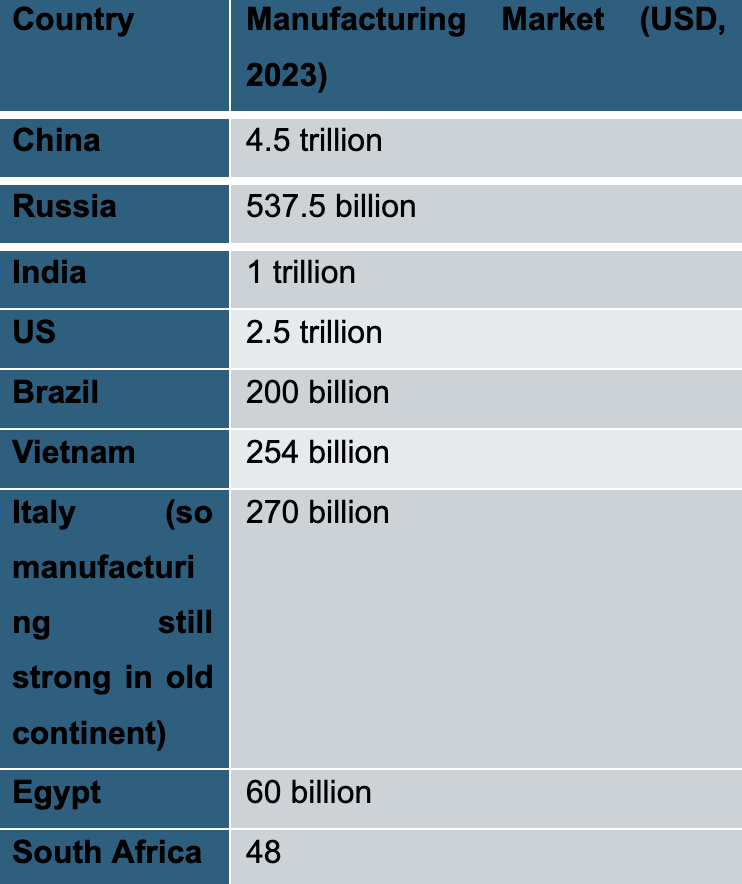
Apart from China, manufacturing in many economies of the Global South is still lagging compared to advanced economies. Indeed, many of the global South economies are under-industrialized and don’t capture much higher value-added production.
Yet, BRICS+ countries are expanding in productive capabilities, such as infrastructure, industrial output, and agribusiness. In 2009, they had the largest proportion of the world’s population and a big chunk of the global economy, and the numbers are growing every year. Russia and Iran both account for the largest and the second largest gas reserves (Prashad 2024). Moreover, BRICS+ collectively is growing in political yield. In the IMF, BRICS nations control 14.4% of the votes while the EU and the US respectively control 29.3% and 16.5% of the votes (Brütsch and Papa 2012, 14). Brazil, China, India, and Russia are already among the 10 largest shareholders in the IMF (Jacques 2012, 483) and BRICS+ countries are increasingly promoting their agenda in the G20 summits and G20 governance.
BRICS+ countries claim that they are interested in a world order of multipolarity for fairer world governance, yet there might be glaring limits to multipolarity in a world in which the US dollar remains the main currency of all international financial transactions. Indeed, 40% of these international financial transactions are invoiced in US dollars, while the US economy only represents 10% of the world economy (see Prashad, 2024). In addition, the US military outspends by a large margin all other countries that follow combined, which represents a serious structural challenge to the potential of bringing about true multipolarity. As such, BRICS+ is not convincing yet in its multipolarity ambition. However, BRICS+ has been consistent in promoting multilateralism. At each annual summit, BRICS+ invites several new partners and regional organizations to work together in joint programs. With multilateral diplomacy, BRICS+ is also standing out from the management style of the US in international relations, which has become brazenly bilateral under the Trump administration.
It is important to remember that BRICS+ emerged from the context of the 2008 financial crisis, meaning a crisis that was US-induced and in which recovery privileged bailing out corporate interests over protecting people’s savings. Such hypocrisy in the US recovery has cast doubts over the US’s interest in genuine development (internally and externally) and the need for an alternative. Of course, it remains to see if BRICS+ would act differently, yet the group claims to emerge from a need for financial reform since 2008, precisely for those reasons.
As previously discussed in this essay, the financial reform that BRICS+ countries have been planning includes limiting the hegemony of the US dollar, even a process of de-dollarization. Part of the incentive toward a de-dollarized world is limiting the nefarious effects of US economic sanctions. Already 95% of the trade between China and Russia is no longer done in US currency (Ramos, 2023). Iran, another highly sanctioned country by the US, has also a lot to gain from a process of de-dollarization.
One explanation for the enthusiasm toward de-dollarization is that such a process is a response to the financial subordination that many Global South nations endure (Alami, Alves, Bonizzi, et al., 2023). In practice, de-dollarization is still budding given the prevalence of US dollars in the international financial and monetary system and BRICS+ plan to launch its own currency has not yet materialized and may even face harsh US sanctions under President Donald Trump. Money transfers are also still relying heavily on the Western controlled Society for Worldwide Interbank Financial Telecommunication or the SWIFT network. But BRICS+ countries have been able to bypass SWIFT with new instruments such as the BCBPI. Abu Dhabi has even launched its own system of cross-border payments in 2018, Buna, operated by the Arab Regional Payments Clearing and Settlement Organization (ARPCSO), which is owned by the Arab Monetary Fund. There is also the development of digital currency alternatives, like in the case of digital currency platforms such as mBridge, a trial initiative of the Bank of International Settlements and the central banks of China, Thailand, and the UAE (Prashad 2024). Despite the uncertainties about a BRICS+ currency that would dethrone the US dollar supremacy, a more realistic and likely scenario would be to see the Chinese Yuan or Renminbi system become the new BRICS+ reserve and replace US dollar hegemony.
Conclusion
Still at an early stage of growth, BRICS+ is becoming a significant platform for multilateral engagement between major Global South countries outside of the predominant order. This is particularly visible in BRICS+ efforts towards international financial reform, notably with the NDB empowering Global South currencies.
The criticism towards BRICS+ has been raising legitimate concerns about abuses of power in BRICS+ countries’ domestic politics. As such, BRICS+ could be another bureaucratic organization that reproduces systems of hegemony and power abuse instead of curing those ailments. However, given that BRICS+ is a serious contender to break away from the US/West dominance in international relations, and finance, the BRICS+ project could create a counterweight in the international financial system.
For the next BRICS+ summit in September 2026 in New Delhi, the group will celebrate the 20th anniversary of the organization. The meeting will also reflect on the current issues of a fragmented world order and geopolitical divides inside the group, notably the Iran/UAE standoff. The stalemate on the US-Israeli offensive on Iran has captured the attention of the world. The lack of due process to authorize the offensive has delegitimized and put in question the leadership of the US and the West in international politics. It seems that a Western rule-based order could be collapsing. It remains to be seen if BRICS+ can use its platform to empower Global South countries to circumvent dominant political and financial systems.
Bibliography
Acharya, Amitav, ed. Why Govern? Rethinking Demand and Progress in Global Governance. Cambridge. Cambridge University Press, 2016.
Alami, Ilias. Money power and financial capital in emerging markets: Facing the liquidity tsunami. Routledge, 2019.
Alami, Ilias, Carolina Alves, Bruno Bonizzi, Annina Kaltenbrunner, Kai Koddenbrock, Ingrid Kvangraven, and Jeff Powell. “International Financial Subordination: A Critical Research Agenda.” Review of International Political Economy 30, no. 4 (2023): 1360–1386.
Brancoli, Fernando. “The Weaponization of the Financial System: Debates from the BRICS and G20 Meetings in Rio de Janeiro,” Security in Context, August 9, 2024. https://www.securityincontext.org/posts/weaponization-of-the-financial-system-debates-from-brics-and-g20-meetings-rio-de-janeiro
Brütsch, Christian, and Mihaela Papa. “Deconstructing the BRICs: Bargaining Coalition, Imagined Community or Geopolitical Fad?” CRP Working Paper No. 5, October 2012. Cambridge: Centre for Rising Powers, Department of Politics and International Studies, University of Cambridge.
Gehre, Thiago. “The History of BRICS’ International Relations (2009–2019): Discourses, Innovation and Sensitivities.” Conjuntura Austral: Journal of the Global South (2020). https://doi.org/10.22456/2178-8839.97954.
Jacques, Martin. When China Rules the World: The End of the Western World and the Birth of a New Global Order. Penguin Books, 2012.
Pant, Harsh V. “The BRICS Fallacy.” In Indian Foreign Policy. Manchester University Press, 2016.
Pithouse, Richard. “Brics Is No Emancipatory Project,” Mail & Guardian, 27 July 2018. https://mg.co.za/2018-07-27-brics-is-no-emancipatory-project/
Prashad, Vijay. “Is the Reign of the Dollar Coming to an End?” Tricontinental: Institute for Social Research, The Twenty-Fifth Newsletter, 2024.
Ramos, Marcos. “Dedollarization: 95% of trade between China and Russia is no longer done in US currency,” peoplesdispatch, December 19, 2023. https://peoplesdispatch.org/2023/12/19/dedollarization-95-of-trade-between-china-and-russia-is-no-longer-done-in-us-currency/
Sergunin, Alexander, and Feng Gao. “BRICS as the Subject of Study of International Relations Theory.” International Organisations Research Journal 13, no. 4 (2018): 55–73. https://doi.org/10.17323/1996-7845-2018-04-03
More
Research
The Growing BRICS+: A New World Order?


